
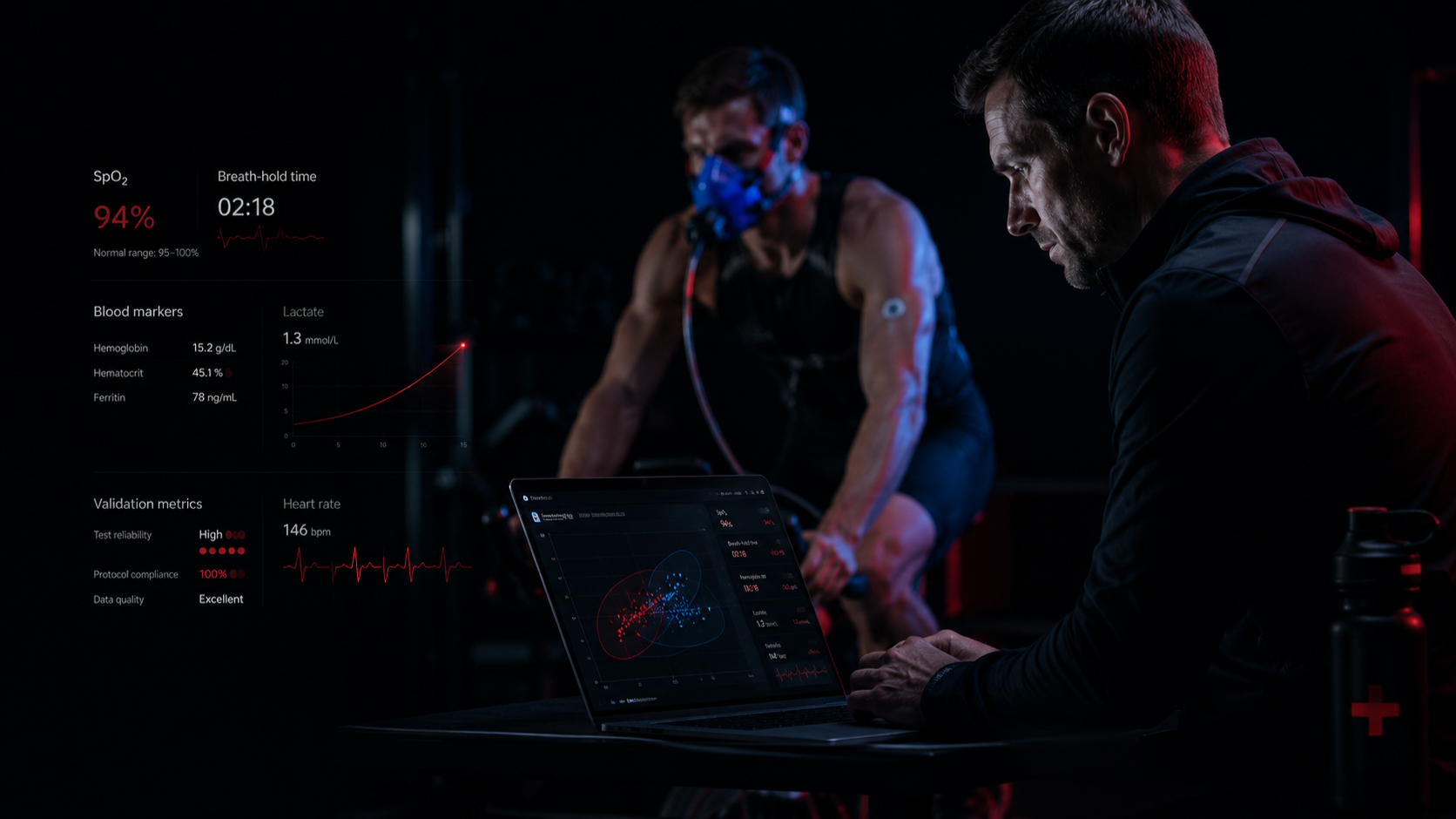
Structured test data is welcome
How to Test RedPlus on Athletes
RedPlus welcomes test results from all protocol levels — A, B and C — including app data, performance results, blood markers, training-load data and combined protocols with heat training, altitude exposure or other performance tools.
With user permission, selected results may be reviewed and used to support future RedPlus development, protocol refinement and knowledge building.
The key requirement is structure: the test should be clear, consistent and easy to interpret.
All structured data is useful. Stronger protocols create stronger conclusions.
Explanation:
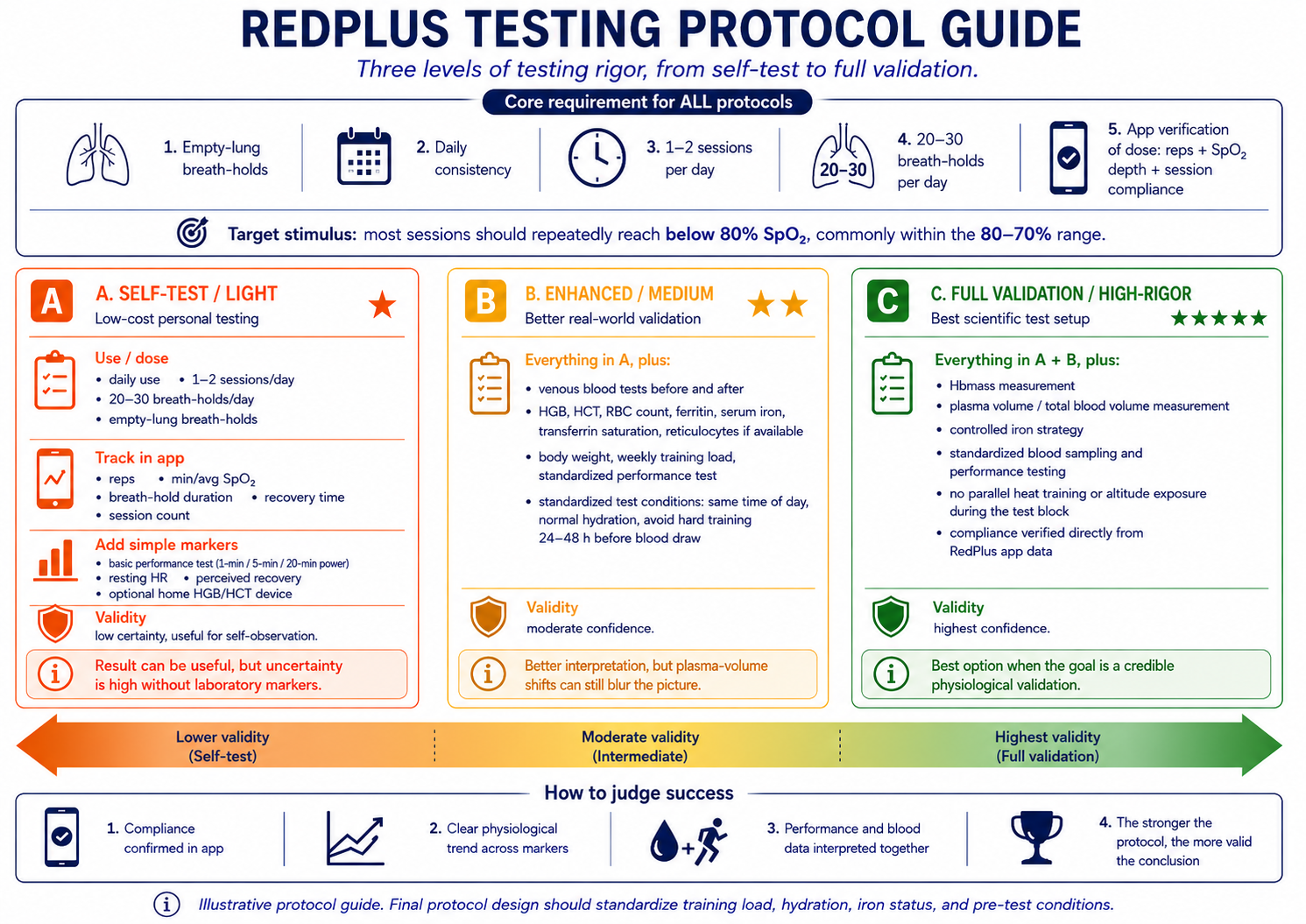
RedPlus test results should only be interpreted as meaningful when the protocol is followed consistently.
A light home test can be useful for personal observation, but it cannot be treated as a full validation unless the athlete reaches the required dose, controls key confounders and tracks the main performance markers.
For a credible RedPlus test, the athlete should complete 1–2 sessions per day, with approximately 20–30 empty-lung breath-holds per day, over a minimum period of 4 weeks. The goal is not simply to hold the breath for as long as possible, but to reach a controlled hypoxic stimulus, with most sessions repeatedly entering the target SpO₂ range, ideally around the 80–70% zone.
To evaluate performance impact, athletes should test relevant baseline markers before starting, during the test period and after completion. For cyclists and endurance athletes, this may include 1-minute, 5-minute and 20-minute power tests, combined with app data such as breath-hold count, SpO₂ depth, recovery time and session consistency.
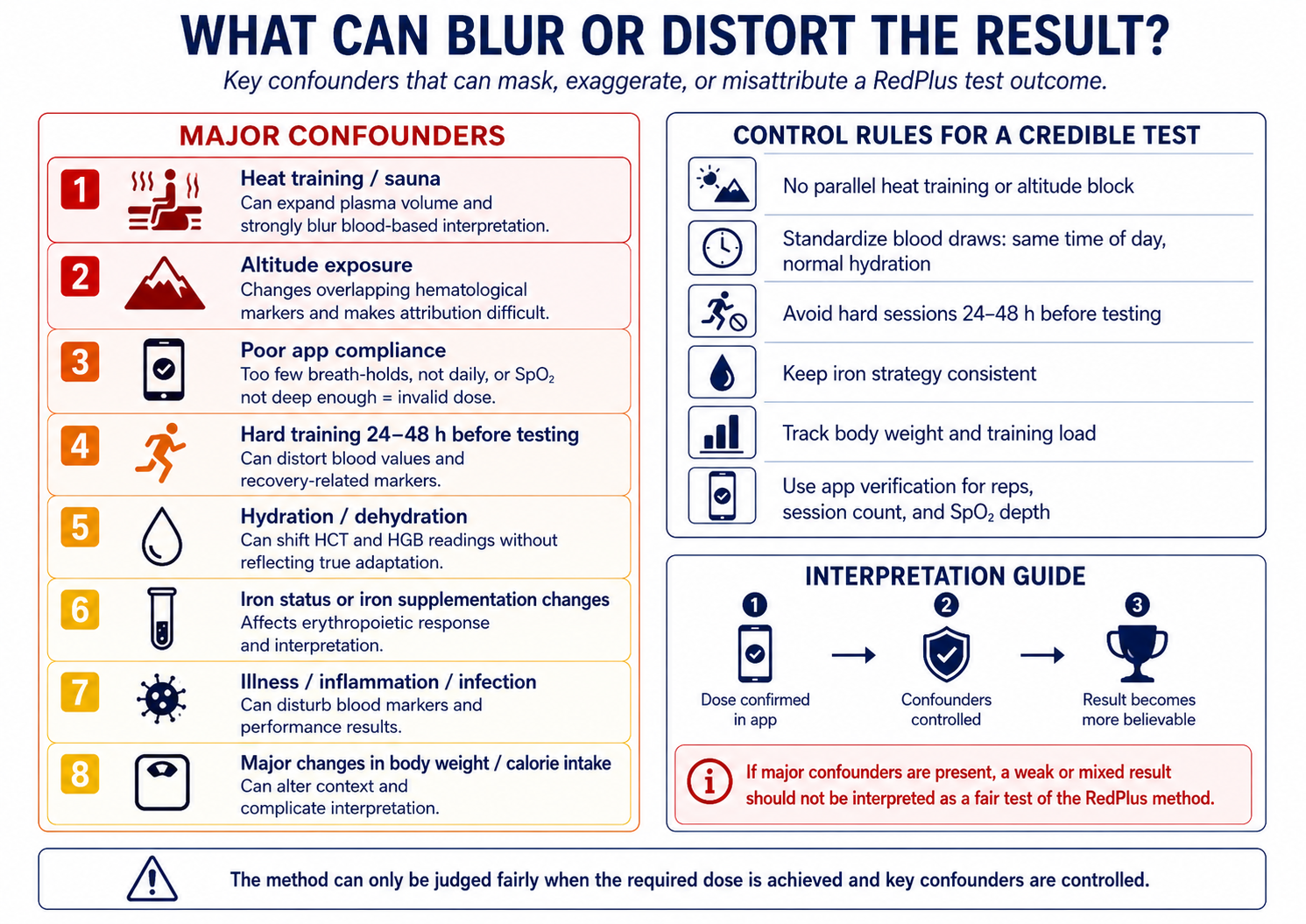
If the required dose is not achieved, or if major confounders such as heat training, altitude exposure, illness, dehydration, inconsistent iron strategy or hard training before blood testing are present, the result should not be interpreted as a fair test of the RedPlus method.
Important distinction: useful training vs. clean testing
Some of the listed factors are not negative in themselves. Heat training, sauna, altitude exposure and changes in training load may all be useful performance tools and may even be combined with RedPlus in a broader training strategy.
However, they should not be mixed into a controlled RedPlus validation test unless the goal is specifically to test the combined effect.
For a clean RedPlus test, the objective is to isolate the RedPlus stimulus as much as possible. If heat training, altitude exposure, major training-load changes, dehydration, illness or iron-strategy changes are introduced at the same time, the result becomes difficult to interpret.
In that situation, a positive result may not be attributable to RedPlus alone — and a weak result may not fairly represent RedPlus either.
In short: some confounders may be useful training tools, but they reduce the validity of a clean RedPlus test.