
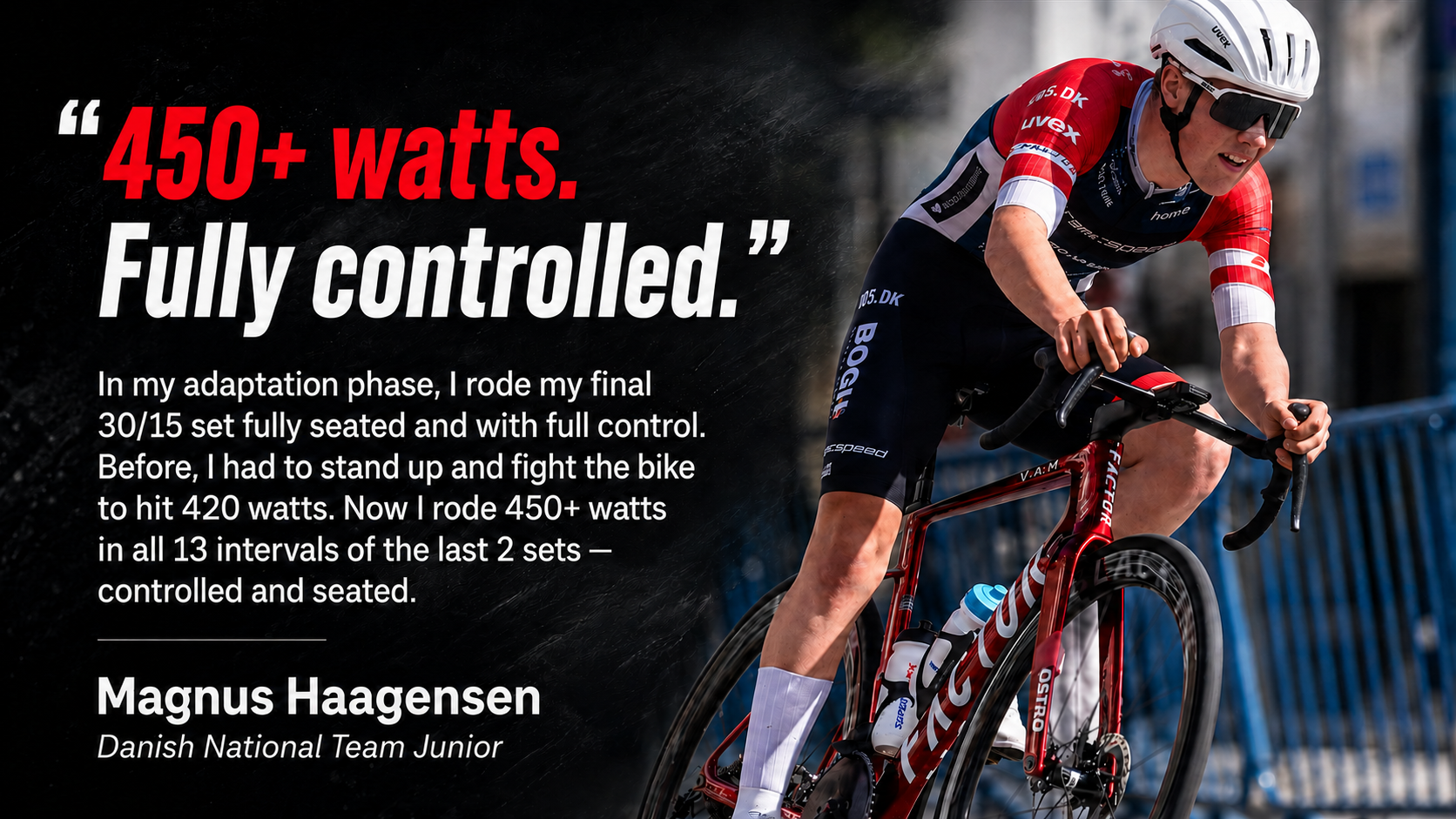
Athlete Observation: Magnus Haagensen
Magnus Haagensen is a Danish U19 national team rider who, at the time of writing, has followed the RedPlus protocol for 15 weeks.
His protocol has included a long build phase, a four-week peak phase, a de-acclimatisation phase, and he is now entering a maintenance period.
Throughout the test period, Magnus has been closely followed in cooperation with his coach, Martin Mortensen, former professional cyclist, who has also followed the RedPlus project closely.
One of the most consistent subjective observations from Magnus has been improved recovery. In his own words:
“I simply have fewer bad days.”
During a spring training camp in Spain with the senior team, Magnus was still in the build phase. Already at this point, he showed a clear performance progression. This may, of course, also be related to increased training load and natural development, but one notable observation was that his estimated VO₂max appeared high compared with several of the senior elite riders present at the camp.
Later in the process, Magnus repeatedly reported new personal best performances. A key point of interest was the transition into the peak phase, where the protocol increased both the number of repetitions and the depth of SpO₂ exposure. The concern was whether this would create additional fatigue or stress. According to Magnus, this was not the case. He did not report feeling more stressed, and his Garmin sleep data did not show any meaningful negative deviation during this period.
Another important observation was that on two occasions Magnus was unable to lower his SpO₂ as expected during the protocol. Based on previous internal testing, this may be linked to early signs of illness or viral stress. In both cases, Magnus became slightly ill one to two days later. This supports our working observation that SpO₂ response may also provide useful feedback about recovery status, illness risk and daily training readiness.
The de-acclimatisation phase was especially interesting. After seven days, Magnus reported a marked improvement in his 30/15-second interval sessions. Across two sets, he improved every interval by more than 30 watts. He also reported that he completed the intervals seated, without needing to stand and force the effort.
Three days later, at his first major race target, Magnus reported having “star legs” and feeling extremely strong. Unfortunately, he crashed at high speed approximately 150 metres before the finish and had to run across the line with his bike.
Following the crash, Magnus also reported that he felt he recovered unusually quickly. Less than a week later, he started a stage race and was fully competitive again.
These observations do not prove causation, but they provide a valuable real-world athlete case showing how the RedPlus protocol may support recovery, performance progression, SpO₂-guided readiness insights, and peak-phase preparation in a high-level young endurance athlete.
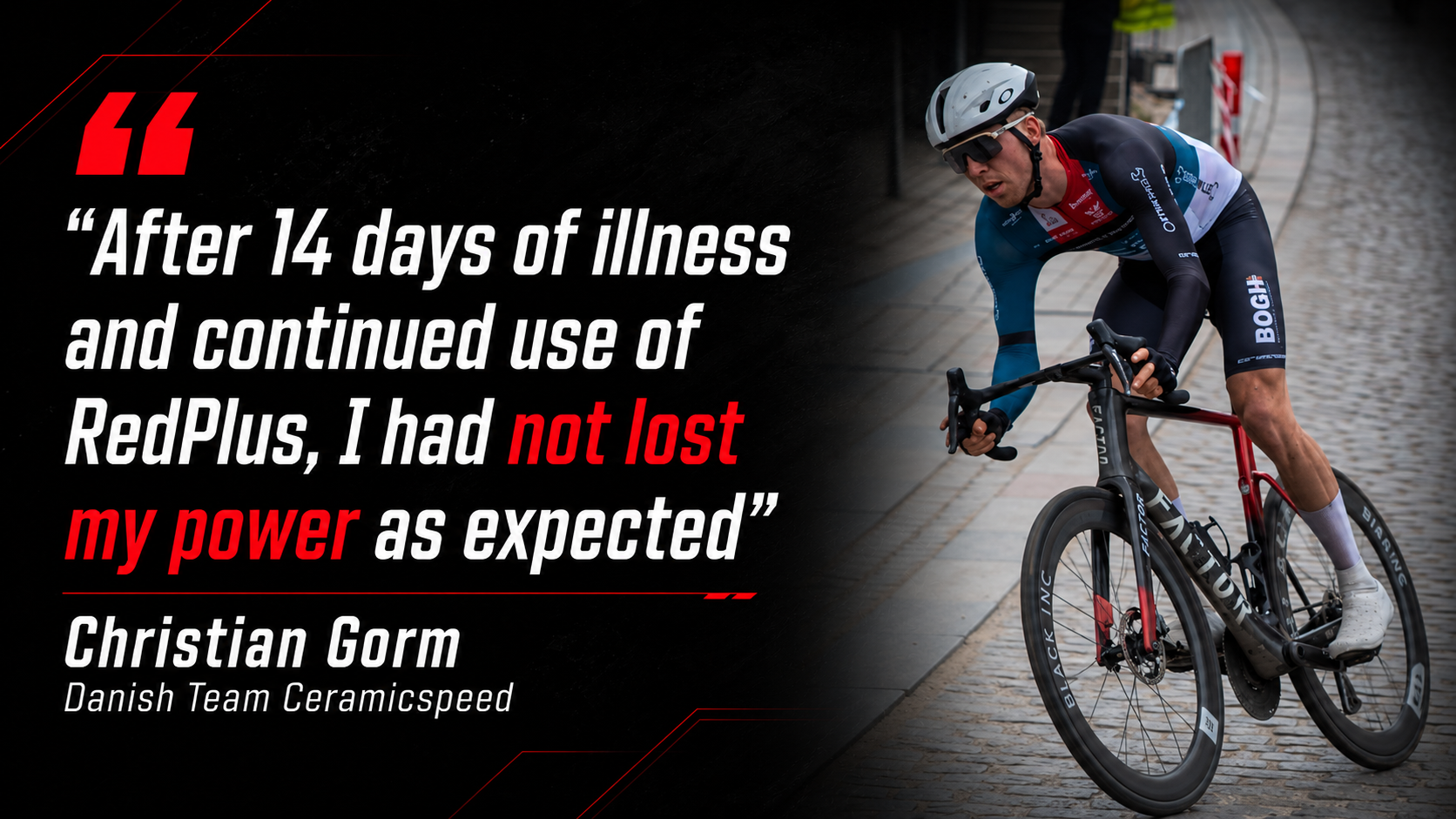
Athlete & Coach Observation: Christian Gorm
Christian Gorm is an elite rider for Team CeramicSpeed and also works as a coach for several riders. He has practiced RedPlus as part of his own training and has reported a perceived recovery benefit during the process.
One notable observation came during a training camp, which Danish U19 national team rider Magnus Haagensen also attended. Early in the camp, Christian was involved in a crash and was naturally concerned about how his body would respond. In a normal training-camp setting, where riders accumulate many hours in the saddle and train with high intensity, a crash early in the camp could easily compromise the remaining days.
However, Christian reported that his body appeared to recover faster than expected. Despite the crash, he was able to continue the training camp and came out of it with a strong overall response. He felt that he may have been one of the riders on the team who came through the camp best, with both surplus energy and clear performance progression.
Later in the process, Christian became ill and was unable to train for approximately 14 days. During this period, he continued to practice RedPlus as part of his routine. When he returned to cycling, the expectation was that his performance level would have dropped significantly after two weeks without training.
Instead, Christian reported that he had not lost as much peak power or endurance as expected. Rather than feeling as if he was starting from a much lower level, he felt that he returned from a higher baseline than anticipated.
Christian has since introduced RedPlus to other riders he coaches, and their observations will be followed with interest as more real-world athlete feedback becomes available.
This is an athlete and coach observation, not a controlled clinical study. However, it provides another relevant real-world case suggesting that RedPlus may support recovery perception, performance resilience and return-to-training readiness in endurance athletes.
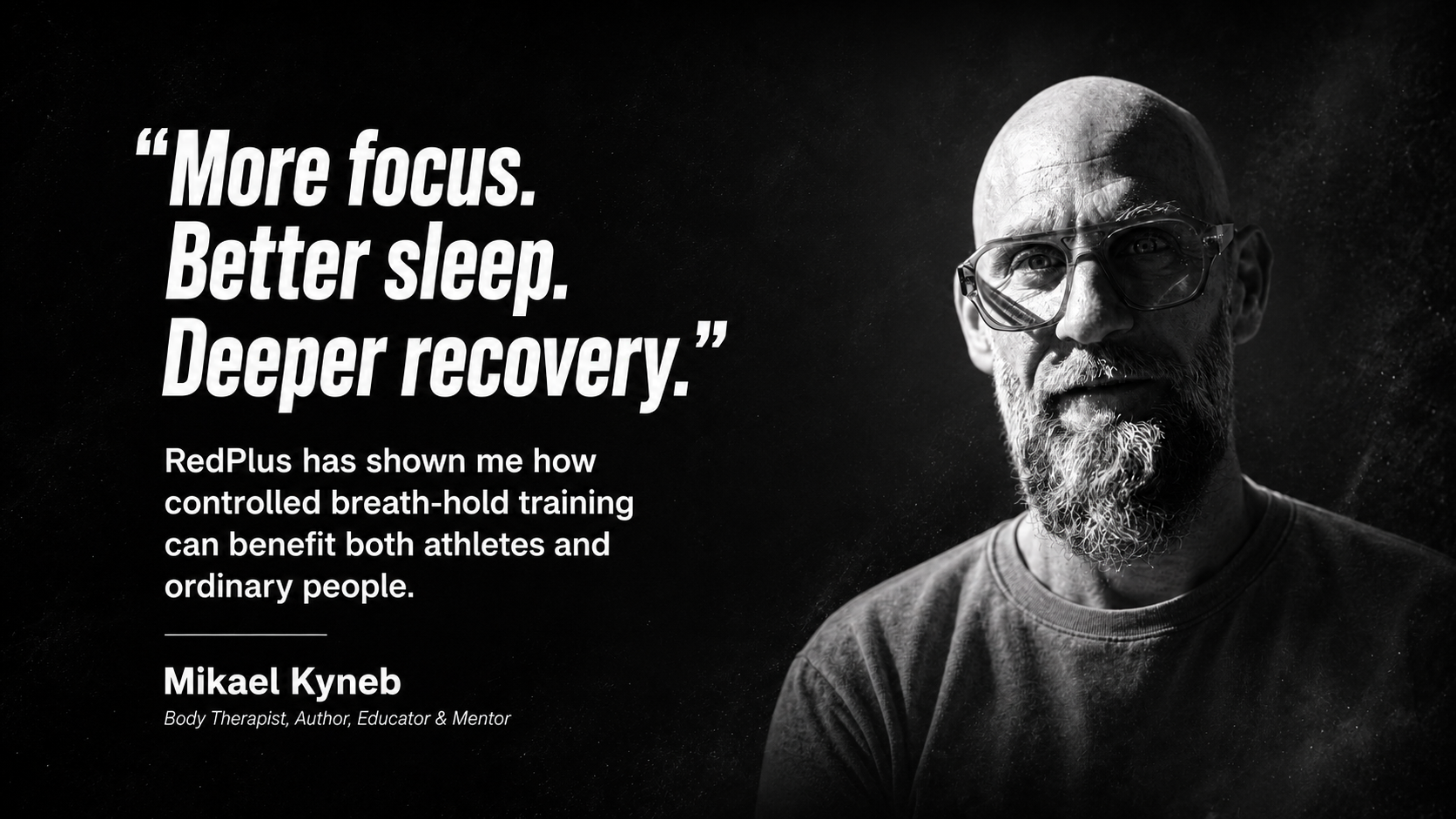
Practitioner Observation: Mikael Kyneb
Michael Kyneb is a body therapist, author and former professional cyclist. He works with WorldTour teams and elite riders and has tested RedPlus to better understand how the protocol may support athletes in performance, recovery and stress regulation.
Michael also uses meditation and body-based relaxation techniques in his work with athletes. During his own RedPlus testing, he integrated the protocol into a meditative setting and observed a markedly different physiological response than what he would normally expect from meditation alone.
According to Michael, RedPlus appeared to help the body enter an unusually deep state of calm, balance and nervous-system downregulation. One of the most notable observations was an exceptionally low heart-rate response, with heart rate dropping below 30 bpm during the session. While meditation and deep relaxation can reduce heart rate, Michael described this response as unusual because it went significantly beyond what he would normally experience — even compared with his resting heart rate during his years as a professional cyclist in the 1990s.
Another notable observation was his breath-hold duration. In several sessions, when combining RedPlus with meditation, Michael was able to hold his breath for more than two minutes, and in some cases close to or above three minutes. This is unusual compared with most athletes observed in the RedPlus testing process, who typically hold their breath somewhere between approximately one minute and 1:45. Apart from RedPlus founder Niels Andersen, who has also exceeded three minutes in selected sessions, this level of breath-hold duration has not commonly been observed among the athletes tested so far.
Michael has also observed a pattern that aligns with both internal RedPlus testing and the athlete observation from Danish U19 national team rider Magnus Horgersen. On two separate occasions, Michael was unable to lower his SpO₂ below approximately 88% during the protocol. In both cases, he became ill shortly afterwards — once the following day, and once a few days later.
This mirrors similar observations from other RedPlus test cases, where an unusually limited SpO₂ drop appeared shortly before illness symptoms developed. While this does not prove causation, it supports the working hypothesis that SpO₂ response during the protocol may provide useful feedback on recovery status, immune stress or early illness risk.
From an athletic performance perspective, this could become highly relevant. If an athlete’s body does not respond normally to the hypoxic stimulus, it may indicate that the athlete is not fully ready for high training stress that day. This could make RedPlus useful not only as a performance stimulus, but also as a practical readiness and recovery feedback tool.
Based on his experience, Michael believes RedPlus may have potential not only for performance development, but also for recovery, stress reduction and nervous-system regulation.
This is a practitioner observation and not a controlled clinical study. However, it provides a valuable real-world indication that RedPlus may influence both performance-related adaptation and recovery-state regulation.
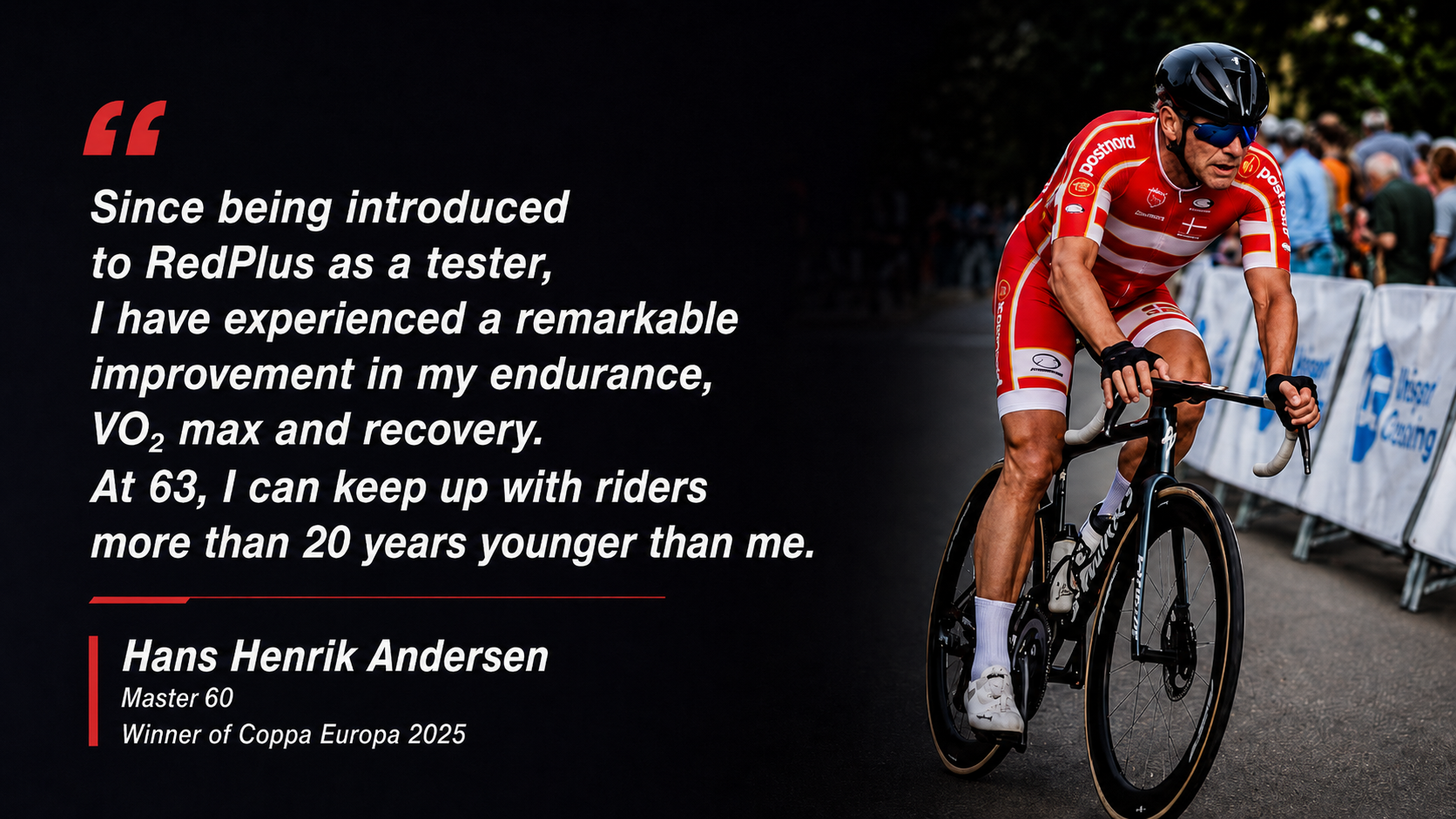
Master Athlete Observation: Hans Henrik Andersen
Hans Andersen is a 63-year-old Master 60 cyclist and winner of the Copa de Europa de Masters 2025. He has practiced empty-lung hypoxic breath-hold training introduced by RedPlus founder Niels Andersen before the RedPlus beta version was completed.
Hans used the protocol in the lead-up to the 2025 European Cup in Mallorca, which he went on to win. During the 2025 season, he also achieved three master podium results, showing that he was able to remain highly competitive at international master level.
Throughout the process, Hans reported a clear improvement in his breathing. In his own words:
“I simply have better breathing than before.”
He also reported a noticeably improved recovery response. This is particularly interesting given that Hans competes against riders who are often more than 20 years younger than him, while still maintaining a high level of explosiveness and race performance despite his age.
Hans later expressed his overall impression of the protocol clearly:
“There is no doubt that this has an effect.”
This feedback should be understood in context. Hans Andersen has been cycling his entire life and knows his body extremely well, which makes his subjective observations valuable. However, this is not a controlled clinical study and does not prove that RedPlus alone caused the performance outcomes.
Nevertheless, his feedback adds another real-world athlete observation suggesting that RedPlus may support breathing efficiency, recovery perception and performance resilience in experienced endurance athletes.