
Apnea Warm-Up Study 2026
RedPlus finds this newly published 2026 study highly interesting, because it supports one of the core principles behind our work: the body does respond to breath-hold induced stress.
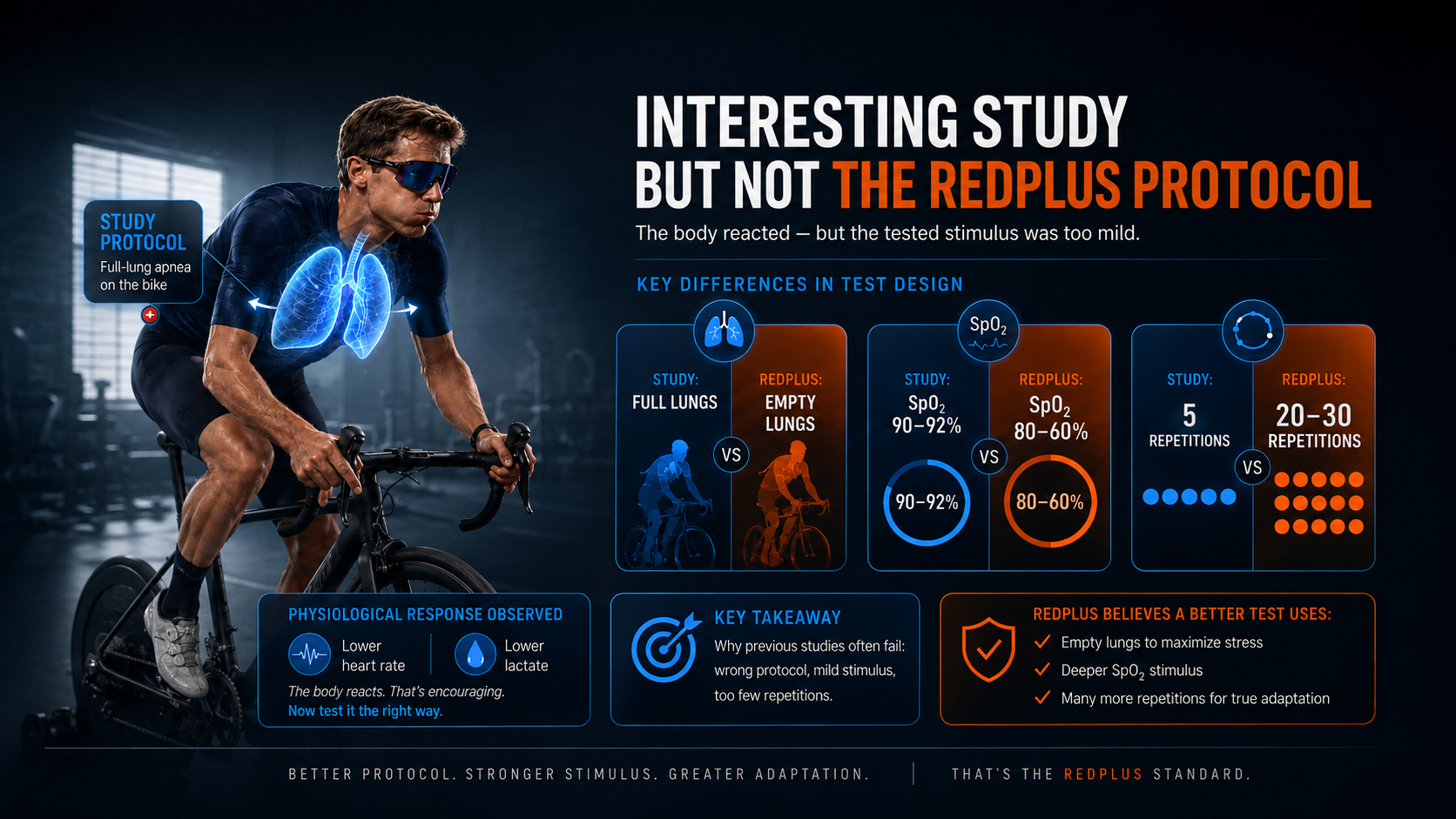
In the study, professional cyclists performed repeated dry dynamic apneas during warm-up. The researchers found no improvement in time-to-exhaustion performance, but they did observe physiological changes, including a lower heart rate at the end of the warm-up and lower post-exercise lactate. This is important, because it shows that the body reacts — even when the protocol is not strong enough to produce a performance benefit.
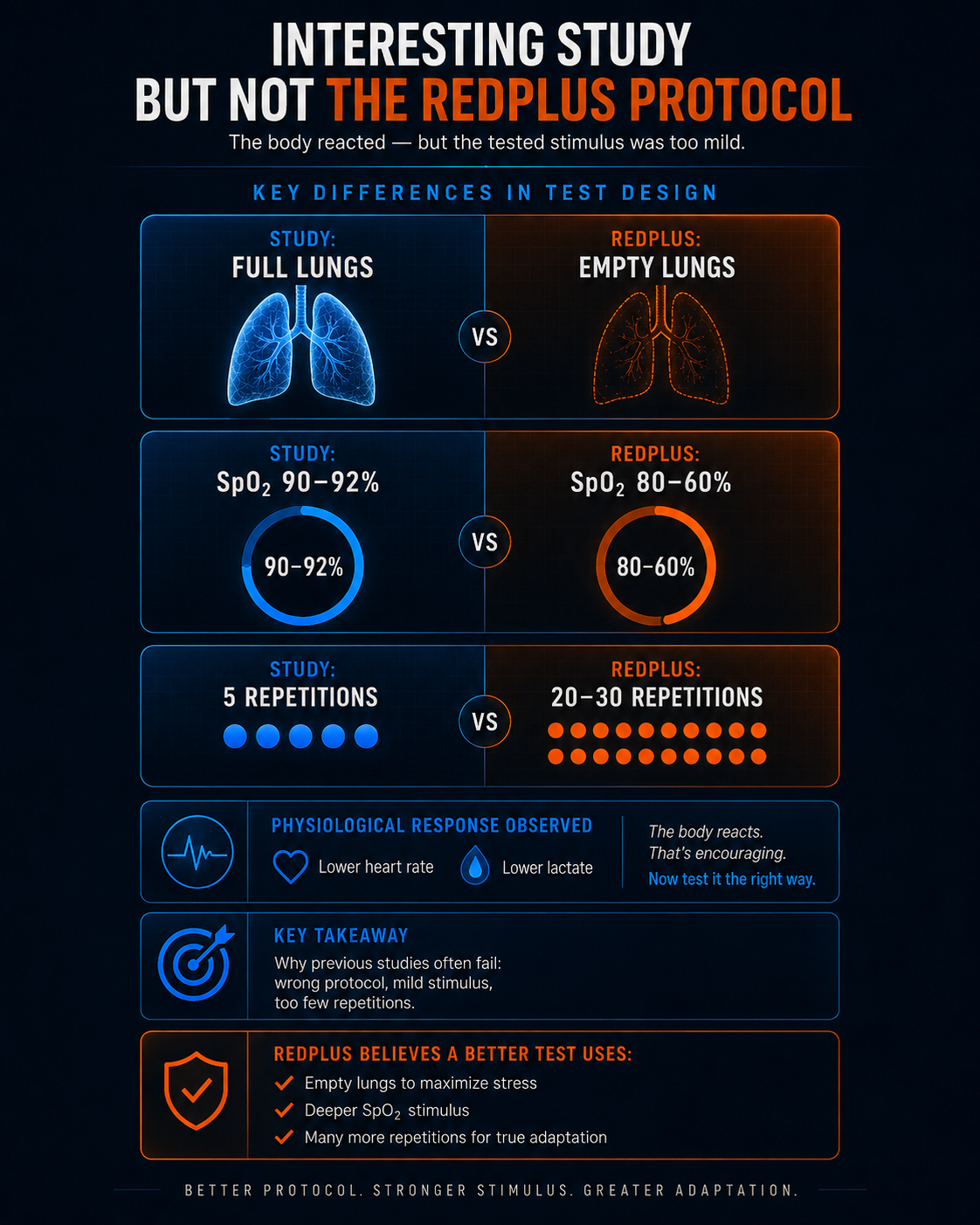
From a RedPlus perspective, the study is especially relevant because the protocol differs significantly from ours in three key ways.
First, the athletes performed breath-holds on full lungs, while RedPlus is based on controlled breath-holds on empty lungs. This is a fundamental difference in how the hypoxic stimulus is created.
Second, the breath-holds were performed while cycling during warm-up, whereas RedPlus uses a controlled and relaxed setting, allowing the user’s SpO₂ response and recovery to be measured more precisely.
Third, the SpO₂ reduction in the study was relatively mild. In the RedPlus framework, this level of stimulus would be considered too low to expect a meaningful adaptive response. RedPlus is designed to guide users toward a more relevant and measurable hypoxic stimulus, using SpO₂ zones, repetition dose, recovery tracking and consistency over time.
For RedPlus, this study is therefore not a negative result. It is a useful example of why protocol design matters. The study shows that apnea can create a physiological response, but also that too few repetitions, full-lung breath-holds, active cycling during the intervention and insufficient SpO₂ reduction are unlikely to produce a meaningful performance effect.
This supports the core RedPlus position: breath-holding alone is not enough. The effect depends on correct lung volume, sufficient stimulus depth, repeated exposure, recovery control, measurement and consistent dose-controlled training.
Effect of repeated dry dynamic apnea during warm-up on time to exhaustion and physiological responses in professional cyclists