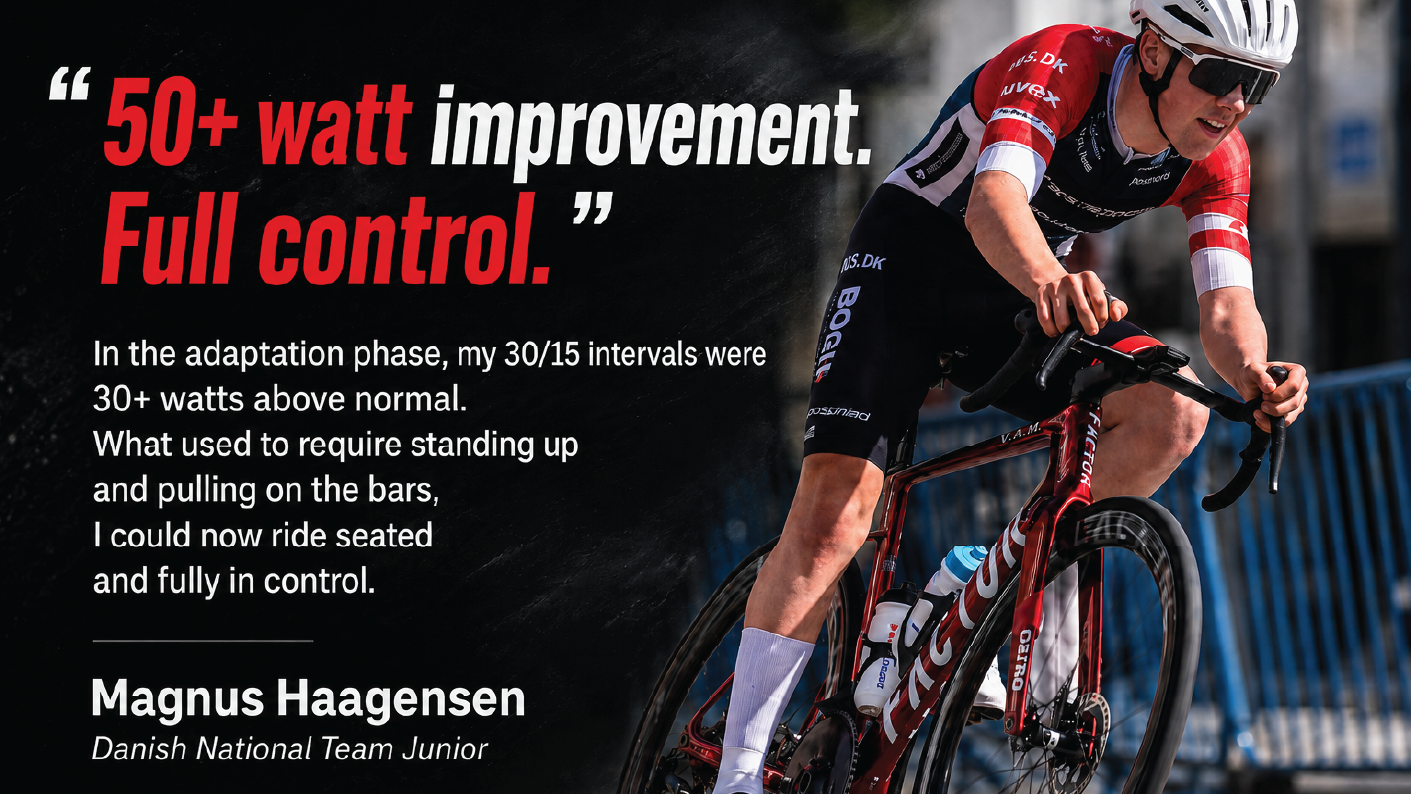
Athlete Observation: Magnus Haagensen
Magnus Haagensen is a Danish U19 national team rider who, at the time of writing, has followed the RedPlus protocol for 15 weeks.
His protocol has included a long build phase, a four-week peak phase, a de-acclimatisation phase, and he is now entering a maintenance period.
Throughout the test period, Magnus has been closely followed in cooperation with his coach, Martin Mortensen, former professional cyclist, who has also followed the RedPlus project closely.
One of the most consistent subjective observations from Magnus has been improved recovery. In his own words:
“I simply have fewer bad days.”
During a spring training camp in Spain with the senior team, Magnus was still in the build phase. Already at this point, he showed a clear performance progression. This may, of course, also be related to increased training load and natural development, but one notable observation was that his estimated VO₂max appeared high compared with several of the senior elite riders present at the camp.
Later in the process, Magnus repeatedly reported new personal best performances. A key point of interest was the transition into the peak phase, where the protocol increased both the number of repetitions and the depth of SpO₂ exposure. The concern was whether this would create additional fatigue or stress. According to Magnus, this was not the case. He did not report feeling more stressed, and his Garmin sleep data did not show any meaningful negative deviation during this period.
Another important observation was that on two occasions Magnus was unable to lower his SpO₂ as expected during the protocol. Based on previous internal testing, this may be linked to early signs of illness or viral stress. In both cases, Magnus became slightly ill one to two days later. This supports our working observation that SpO₂ response may also provide useful feedback about recovery status, illness risk and daily training readiness.
The de-acclimatisation phase was especially interesting. After seven days, Magnus reported a marked improvement in his 30/15-second interval sessions. Across two sets, he improved every interval by more than 30 watts. He also reported that he completed the intervals seated, without needing to stand and force the effort.
Three days later, at his first major race target, Magnus reported having “star legs” and feeling extremely strong. Unfortunately, he crashed at high speed approximately 150 metres before the finish and had to run across the line with his bike.
Following the crash, Magnus also reported that he felt he recovered unusually quickly. Less than a week later, he started a stage race and was fully competitive again.
These observations do not prove causation, but they provide a valuable real-world athlete case showing how the RedPlus protocol may support recovery, performance progression, SpO₂-guided readiness insights, and peak-phase preparation in a high-level young endurance athlete.