
Practitioner Observation: Mikael Kyneb
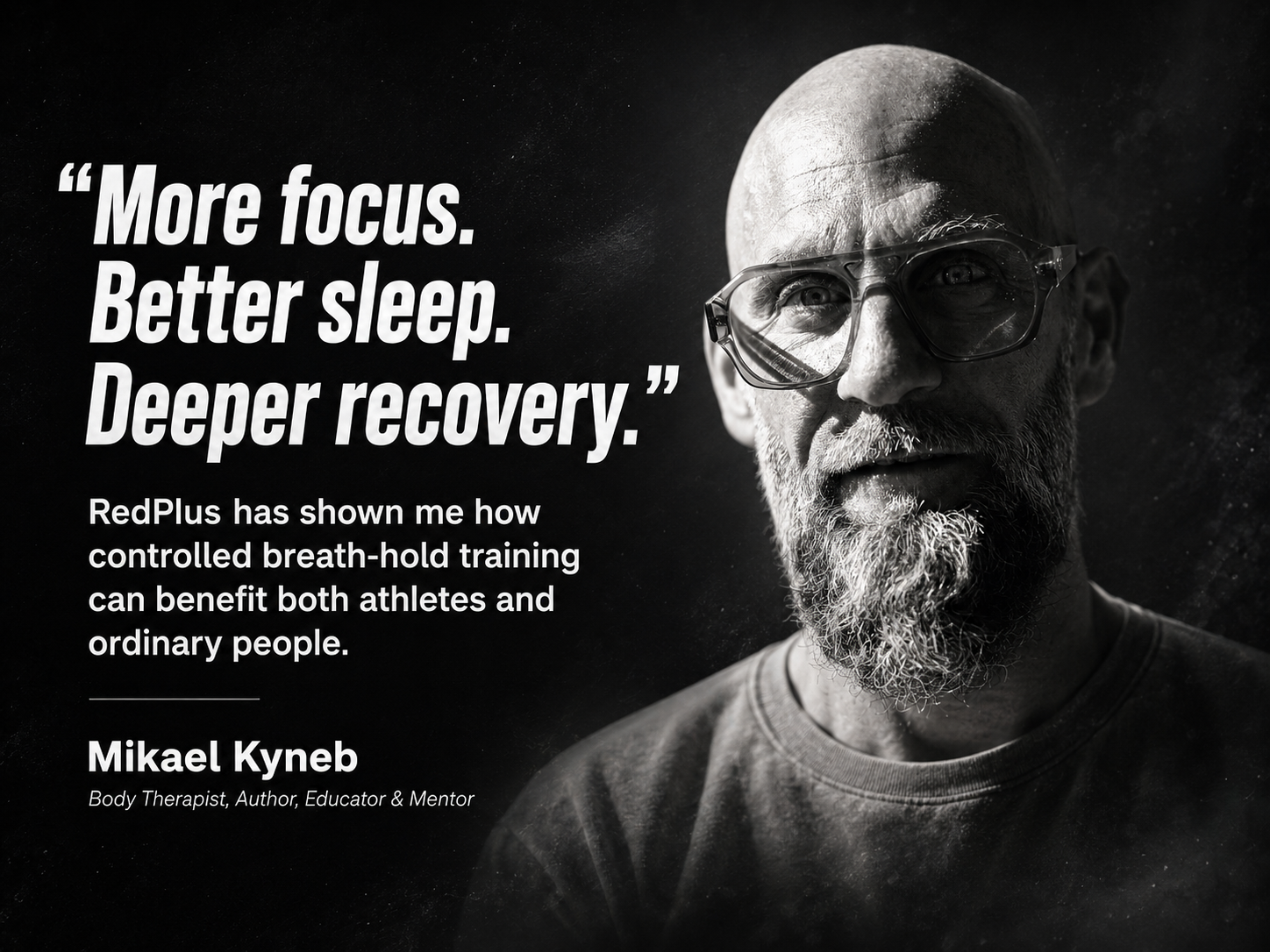
Michael Kyneb is a body therapist, author and former professional cyclist. He works with WorldTour teams and elite riders and has tested RedPlus to better understand how the protocol may support athletes in performance, recovery and stress regulation.
Michael also uses meditation and body-based relaxation techniques in his work with athletes. During his own RedPlus testing, he integrated the protocol into a meditative setting and observed a markedly different physiological response than what he would normally expect from meditation alone.
According to Michael, RedPlus appeared to help the body enter an unusually deep state of calm, balance and nervous-system downregulation. One of the most notable observations was an exceptionally low heart-rate response, with heart rate dropping below 30 bpm during the session. While meditation and deep relaxation can reduce heart rate, Michael described this response as unusual because it went significantly beyond what he would normally experience — even compared with his resting heart rate during his years as a professional cyclist in the 1990s.
Another notable observation was his breath-hold duration. In several sessions, when combining RedPlus with meditation, Michael was able to hold his breath for more than two minutes, and in some cases close to or above three minutes. This is unusual compared with most athletes observed in the RedPlus testing process, who typically hold their breath somewhere between approximately one minute and 1:45. Apart from RedPlus founder Niels Andersen, who has also exceeded three minutes in selected sessions, this level of breath-hold duration has not commonly been observed among the athletes tested so far.
Michael has also observed a pattern that aligns with both internal RedPlus testing and the athlete observation from Danish U19 national team rider Magnus Horgersen. On two separate occasions, Michael was unable to lower his SpO₂ below approximately 88% during the protocol. In both cases, he became ill shortly afterwards — once the following day, and once a few days later.
This mirrors similar observations from other RedPlus test cases, where an unusually limited SpO₂ drop appeared shortly before illness symptoms developed. While this does not prove causation, it supports the working hypothesis that SpO₂ response during the protocol may provide useful feedback on recovery status, immune stress or early illness risk.
From an athletic performance perspective, this could become highly relevant. If an athlete’s body does not respond normally to the hypoxic stimulus, it may indicate that the athlete is not fully ready for high training stress that day. This could make RedPlus useful not only as a performance stimulus, but also as a practical readiness and recovery feedback tool.
Based on his experience, Michael believes RedPlus may have potential not only for performance development, but also for recovery, stress reduction and nervous-system regulation.
This is a practitioner observation and not a controlled clinical study. However, it provides a valuable real-world indication that RedPlus may influence both performance-related adaptation and recovery-state regulation.