
The Overlooked Performance Benefits of Controlled Hypoxia
Beyond red blood cells: capillarization, oxygen efficiency, VO₂max and lactate clearance.
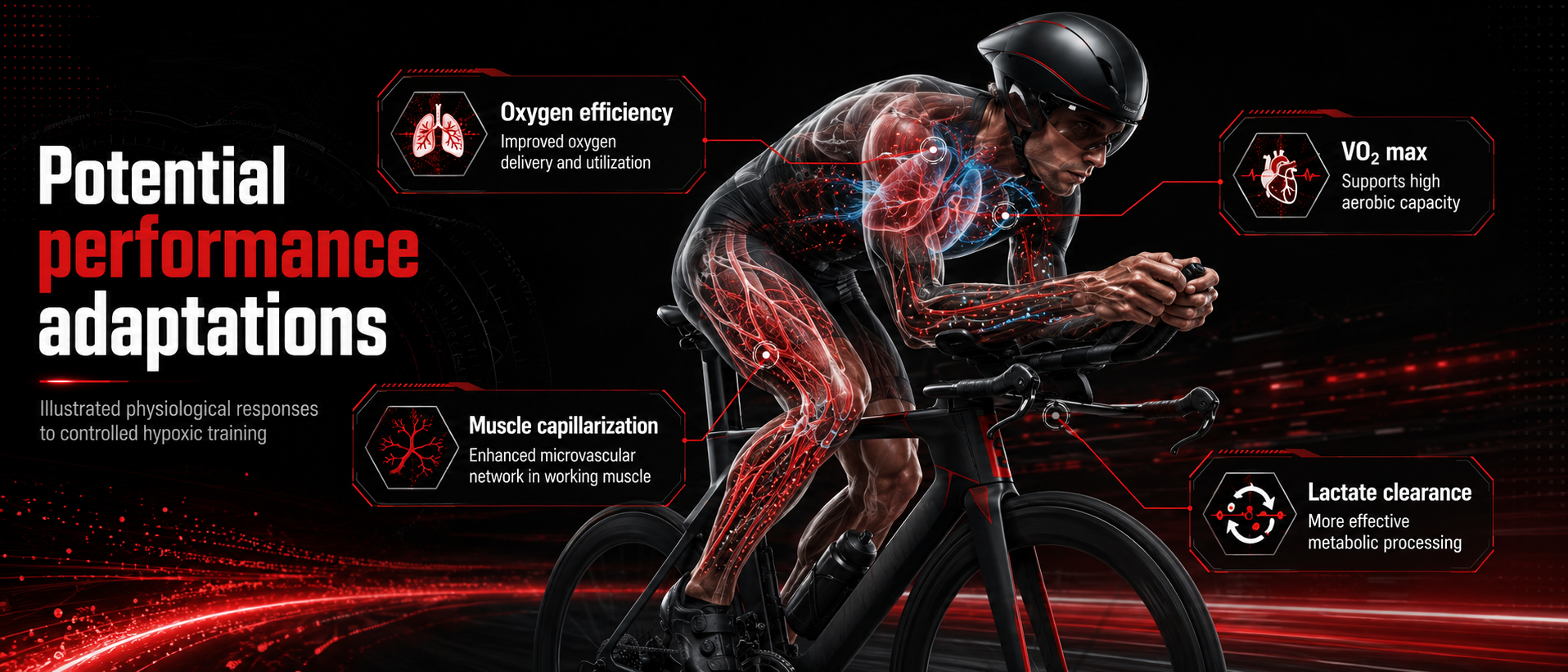
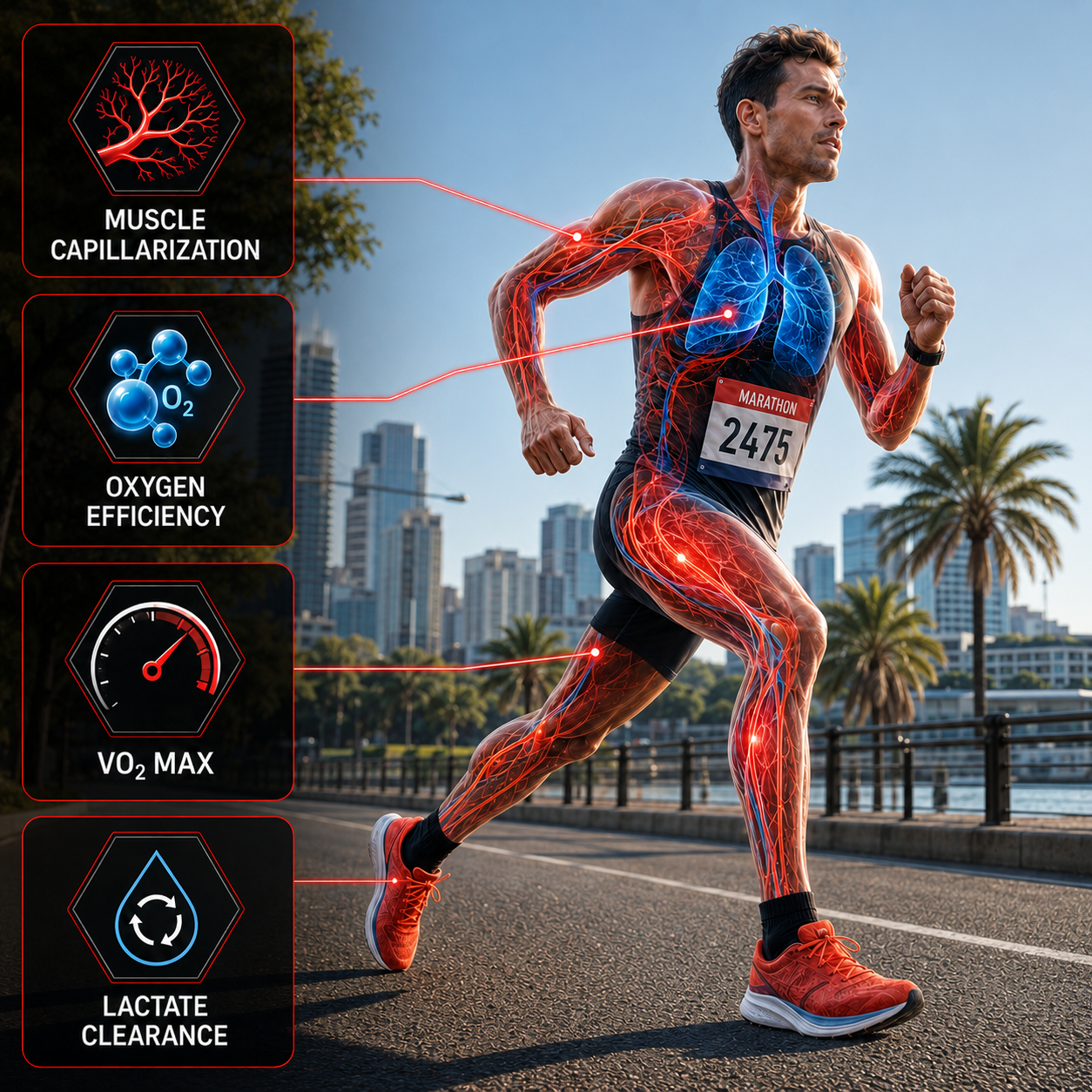
Controlled hypoxic exposure may support vascular adaptation in skeletal muscle. Research on endurance and hypoxic training shows that capillary growth and improved skeletal-muscle microcirculation can occur as part of the adaptive response to repeated oxygen-demand stress. Increased capillarization can improve oxygen diffusion from blood to working muscle and may support greater fatigue resistance during endurance performance.
Increased muscle capillarization
Source: Jensen L, Bangsbo J, Hellsten Y.
Effect of high intensity training on capillarization and presence of angiogenic factors in human skeletal muscle.
J Physiol. 2004;557(Pt 2):571–582. DOI: 10.1113/jphysiol.2003.057711. PMID: 15020701.
Ross M, Andersen TR, et al.
Exercise-induced skeletal muscle angiogenesis: impact of age, sex, angiocrines and cellular mediators. Eur J Appl Physiol. 2023. DOI: 10.1007/s00421-022-05128-6
Improved oxygen efficiency means the athlete may be able to produce more work from the available oxygen supply. This can be influenced by better oxygen delivery, improved muscle extraction, mitochondrial adaptation and more efficient use of aerobic metabolism. Hypoxic training studies suggest that adding a hypoxic stimulus to training can improve aerobic capacity and endurance-related outcomes, although responses vary between athletes and protocols.
Increased oxygen efficiency
Source: Huang Z, Liu Y, et al.
The effects of intermittent hypoxic training on the aerobic capacity of exercisers: a systematic review and meta-analysis. 2023.
Source: Westmacott A, Sanal-Hayes NEM, Bonk S, et al.
High-Intensity Interval Training (HIIT) in Hypoxia Improves Maximal Aerobic Capacity More Than HIIT in Normoxia: A Systematic Review, Meta-Analysis, and Meta-Regression.
Int J Environ Res Public Health. 2022;19(21):14261. DOI: 10.3390/ijerph192114261. PMID: 36361141
Fentaw S, Tadesse T, Birhanu Z.
Methodological and aerobic capacity adaptations of high-intensity interval training at different altitudes in distance runners: A comprehensive meta-analysis.
Physiological Reports. 2025;13:e70349. DOI: 10.14814/phy2.70349
VO₂max reflects the maximal capacity to take up, transport and use oxygen during intense exercise. Meta-analyses show that some forms of intermittent hypoxic training and HIIT in hypoxia can improve VO₂max more than comparable normoxic training, but the effect depends heavily on protocol design, training intensity, duration and athlete level.
Increased VO₂max
Better lactate clearance is not simply about “removing waste”; lactate is also an important fuel and metabolic signal. Endurance-trained athletes show higher lactate flux and clearance capacity, and improvements are linked to oxidative capacity, capillarization and mitochondrial function. Intermittent hypoxic training performed around lactate-threshold intensity has been shown to improve aerobic capacity and endurance performance in cyclists, supporting the idea that hypoxic stress may contribute to better high-intensity endurance tolerance.
Better lactate clearance
Source: Donovan CM, Brooks GA.
Endurance training affects lactate clearance, not lactate production.
Am J Physiol. 1983;244(1):E83–E92.
DOI: 10.1152/ajpendo.1983.244.1.E83
Ross M, Andersen TR, et al. Exercise-induced skeletal muscle angiogenesis: impact of age, sex, angiocrines and cellular mediators. Eur J Appl Physiol. 2023. DOI: 10.1007/s00421-022-05128-6.
(Note: Lactate should not be viewed simply as “waste”; it is also an important fuel source and metabolic signaling molecule involved in endurance performance and adaptation.)